

When people think about rivers, they usually picture large, powerful waterways – the ones that define city skylines or national borders. Yet across Europe, including Ukraine, it is small rivers and streams that form the backbone of freshwater ecosystems. They regulate local microclimates, feed larger rivers, support biodiversity, and absorb excess rainwater. When neglected or poorly managed, they are also the first to disappear – piped underground, polluted, or reduced to dry channels.
In Vinnytsia, a city with approximately 350,000 residents in central Ukraine, dozens of small rivers existed largely out of sight and out of mind. That was the challenge Mariia Smirnova, an architect and expert in sustainable spatial planning, decided to address as an EaP Civil Society Fellow.
Her project focused on developing an integrated approach to mapping and assessing small rivers – a crucial first step for their conservation and sustainable management. Without reliable data, small rivers remain invisible in urban planning, environmental policy, and even public awareness.
“Small rivers are often overlooked, yet they are the most vulnerable part of our freshwater systems. If we don’t see them, measure them, and understand their condition, we cannot protect them or plan cities sustainably,” Mariia says.
From data to community action
Mariia’s approach was simple but powerful: combine field research, digital tools, and citizen participation. Together with local environmental organisations, municipal departments, and volunteers, she led an inventory of 64 small rivers in the Vinnytsia community. Field observations, GIS analysis, and community-based data collection were integrated into a unified, open system.
The result was not just a map, but a living database published as an interactive website and integrated into the Vinnytsia municipality’s internal geoportal. For the first time, small rivers became visible to planners, researchers, activists, and residents alike.
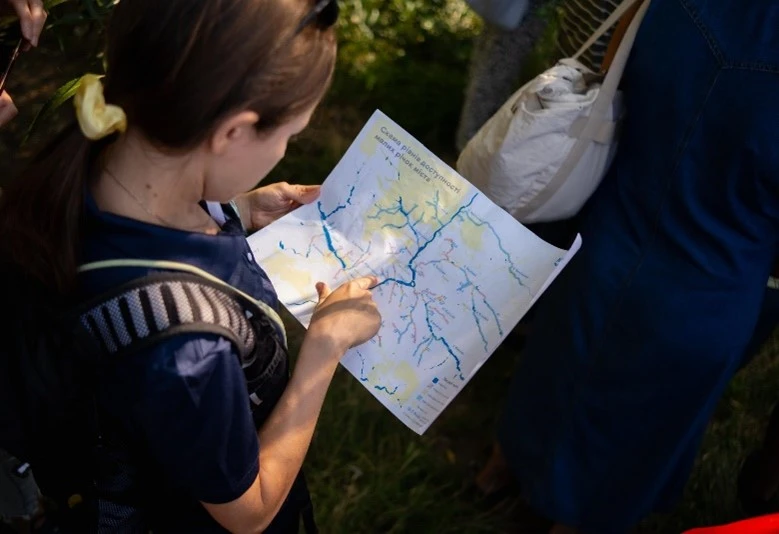
A core part of the Fellowship was public involvement. Mariia and her team trained over 30 volunteers, including activists, students, CSO representatives and municipal staff, to use digital tools for mapping and data collection. For many, this was their first hands-on experience with spatial analysis.
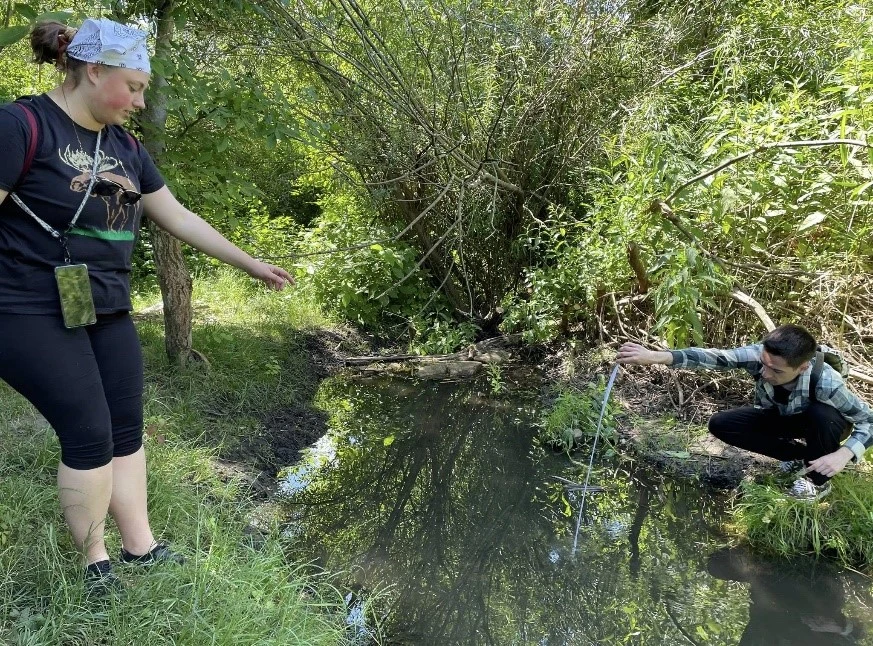
“We explored the source of the Sheremetka River. It is surrounded by a beautiful floodplain forest,” one participant recalls. “But it is difficult to call the river healthy: the riverbed is mostly dry, and there are piles of garbage around it.”
These field experiences turned abstract environmental issues into personal encounters. Volunteers didn’t just collect coordinates; they saw pollution and dried-up riverbeds with their own eyes.
Public events helped widen the circle even further. Urban river walks, cleanup days, lectures, and the “River Talks” festival introduced nearly 150 residents directly to the role small rivers play in the city’s life.
“Such initiatives show that the water heritage of cities is not only large rivers,” representatives of Lvivvodokanal (a water utility company from Lviv) said after visiting the project’s final presentation. “It is also the rivers we do not always notice. They deserve attention, care, and a place in the heart of the community.”
A tool for decisions, not just awareness
What made Mariia’s project stand out was its practical impact. The dataset was transferred to multiple municipal departments and published for free access and download. The first usage data shows it is already being used for urban planning and environmental monitoring. Some universities plan to adopt the methodology for student research, and environmental organisations from other regions expressed interest in replicating the approach.
In just one month after launch, over 1,000 users visited the Small Rivers website, and GIS layers were downloaded thousands of times – a clear sign that the data filled a real gap.
At the same time, the project strengthened local civil society. The Small Rivers public initiative grew from 10 to over 70 members, building a community ready to continue monitoring and advocacy work. “We walked almost 6 km along the river,” a representative of “Small Rivers of Vinnytsia” CSO shared. “We were happy to see so many curious, enthusiastic people who care about small rivers and want to protect them.”
Mariia’s Fellowship showed that protecting small rivers starts with making them visible – on maps, in public discussions, and in decision-making processes. By linking data, people, and institutions, her project laid the groundwork for long-term, evidence-based river management.
“The most important result for me is that the data and the community will live on after my Fellowship project. The map is only the beginning - the real work is continuing research, care, and advocacy for small rivers,” Mariia says.
Find other Featured Stories of our EaP Civil Society Fellows here.
Background information:
Mariia Smirnova is one of the Fellows of the Eastern Partnership Civil Society Fellowship programme funded by the European Union. Its main objective is to support civil society activists or civically minded people from Armenia, Azerbaijan, Belarus, Georgia, Moldova and Ukraine who demonstrate a deep commitment to leading positive social change in their communities. The Eastern Partnership Civil Society Fellowship programme has been running since 2017 and today the Fellowship alumni has 234 Fellows from across the six countries of the Eastern Partnership. Details about the Fellows and their Fellowship projects can be found here.