


An exciting new hybrid course to assist civil society organisation (CSOs) in the Eastern Partnership (Armenia, Azerbaijan, Belarus, Georgia, Moldova and Ukraine) to strengthen their capacity to influence and contribute to policy development and implementation.
The course is composed of a mixture of online preparatory sessions, a 2-day residential workshop, and practical one-to-one coaching. CSOs will have the opportunity to focus on their priority policy concerns and identify how and when to assert their influence, and along the way, to learn how to become successful ‘policy entrepreneurs’.
The course will begin in March 2026 and will be completed by the end of July 2026.
A group of 20 representatives of CSOs and proven activists will be equipped with tools and ideas for taking a new approach to influencing policy-making in their countries. This may be at the national level in reforming for EU integration or being opportunistic in contexts where civic space is restricted, or at the local level, where public service provision needs a shake-up. The course will also provide a framework for how any policy change might be monitored, incorporating ongoing learning and adaptation.
This course is designed for CSOs that have proven capacity and a mission to innovate around policy-making and to advocate for reform. These might be CSOs working at a national or local level, and may be focused on any one or multiple sectors. The CSOs’ staff may be currently in the process of grappling with a policy challenge or at the planning stage.
The approach of the course is to empower a group of ‘policy entrepreneurs’ who, in turn, will share and scale up ‘policy entrepreneurship’ so as to mobilise other civic activists to engage in reforms. Given this ‘training of trainers’ type approach, individuals will be selected to participate in the course in line with the following criteria:
- Proven personal interest in specific policy development or influence;
- At least 5 years’ working experience within civil society;
- In a professional position within a CSO[1] to lead on policy entrepreneurship and to engage other CSOs and activists to be capacitated in policy-making work;
- At least 3 years’ experience in providing training, knowledge/skill transfer, coaching or mentoring;
- Working knowledge of English and at least one local language of the EaP countries
Individual applicants must be endorsed by the senior management of their organisation, and their CSO should demonstrate:
- A mission statement that includes aspirations to public policy change and reform at the national or local level;
- At least 3 years of operation and demonstrable capacity to lead policy development activities, campaigns, and trainings;
- Registration in one of the EaP countries[2];
- A commitment to mobilising stakeholders and building alliances for policy change;
- A commitment to support any selected applicant from their organisation to fully participate in the course and implement agreed follow-up activities.
[1] CSOs are defined in the broadest, most inclusive sense, being “independent actors” (i.e., independent from the State) that are “organised on a not-for-profit and voluntary basis.”
[2] Or for CSOs registered in other countries due to exile, a proven mission focussed on the needs of citizens of their home country within EaP
Selected participants will be asked to join:
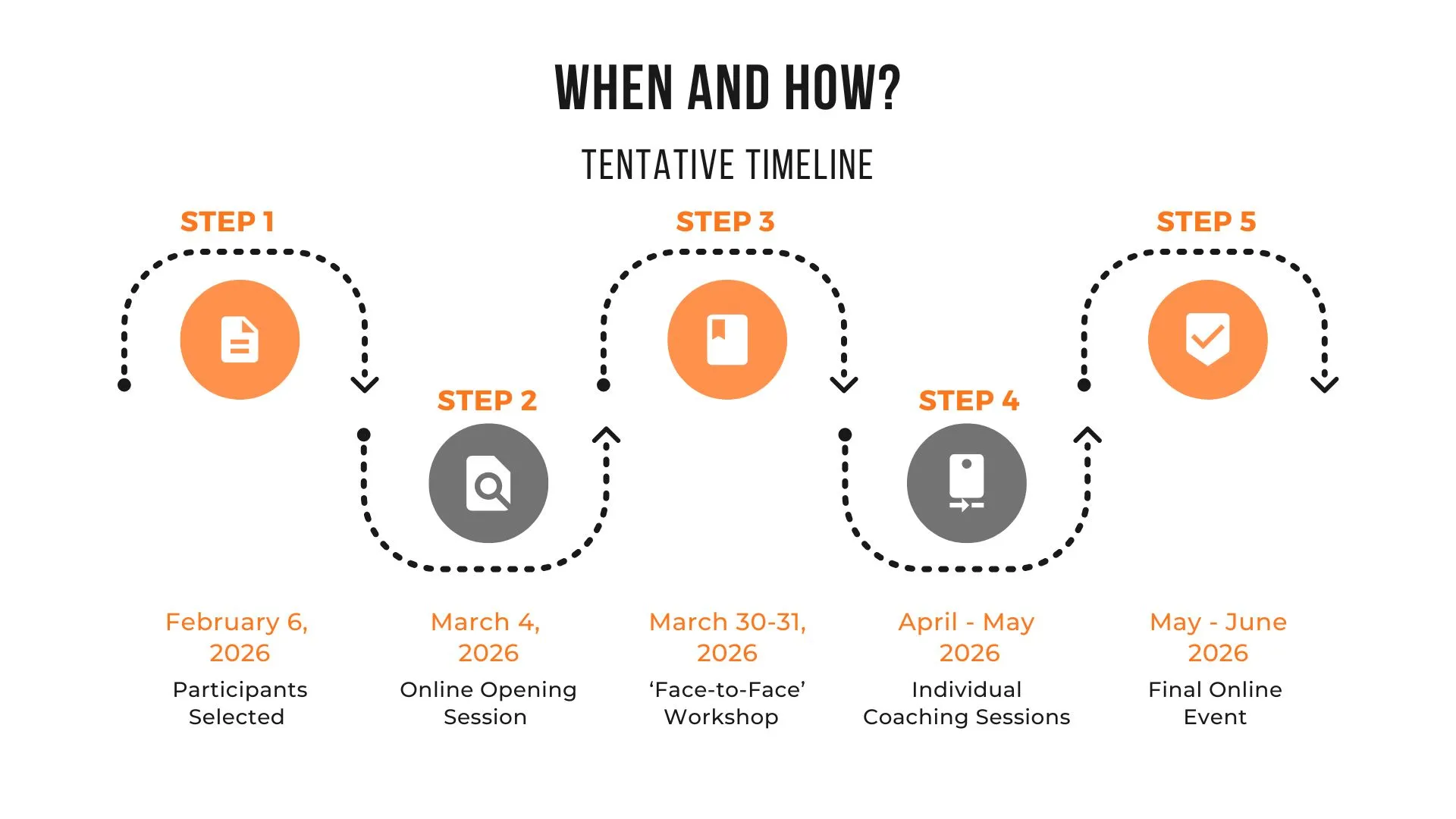
- An online Opening Session on 4th March 2026 to learn about the details of the course, the methodologies that will be used, a review of key concepts, and to have introductions to the training team and other participants.
- A 2-day ‘face-to-face’ workshop in Chisinau (Moldova) will be the main learning event and is scheduled for 30-31st March 2026. The workshop will be a residential, intensive activity, comprising trainer-led sessions and other sessions focused on participants’ practical assignments.
- A number of online, individual coaching sessions during April/May to help participants develop their policy enterprise.
- A final online event in May/June to evaluate progress during the course and next steps.
The course is designed and delivered in partnership with the Centre for Strategy and Development.
Center for Strategy and Development (CSD) is an independent regional organization headquartered in Tbilisi, Georgia, which strives to support good governance, security, and sustainable development, including but not limited to the South Caucasus, the Wider Black Sea area, and Central Asia. CSD provides research, policy analysis, consultancy, and capacity building.
The training team includes:

Victoria Ayer
A skilled facilitator, trainer and project manager, Victoria has helped over 200 civil society advocates around the globe increase their ability to advocate, strategically plan, and hold their governments accountable. As Co-Creator of “Making All Voices Count: a Grand Challenge for Development” (MAVC), Victoria designed and directed a $45 million, multi-donor grants programme that supported 170+ innovators and researchers to advance government accountability and increase citizen engagement. Selected as one of the five founding members of the Board of Directors for the Open Government Partnership (OGP) Support Unit, Ms. Ayer helped incubate and expand a global initiative that now brings together 70+ countries and thousands of civil society organisations to promote transparency, fight corruption, and harness new technologies to strengthen governance. Her extensive experience includes significant public speaking and partnership-building with government, bilateral donors, civil society, media, multilateral institutions, and the private sector.
Victoria received her Juris Doctor degree from Boston University School of Law and a Bachelor of Arts in political science from Rice University.

Stela Leuca
Stela is a recognised leader with more than two decades of experience shaping governance, foreign affairs, and democratic development around the world. While serving as Moldova’s Deputy Minister for Foreign Affairs and European Integration, she led the country’s historic EU accession efforts – negotiating directly with EU institutions and member states, managing EU integration efforts across the whole of Government with thousands of public servants, driving sweeping reforms, promoting Moldova’s accession to the European Union externally, in particular among EU Member States and institutions.
Beyond government, Stela has driven and managed democracy and governance programs with USAID, advanced digital transformation initiatives for the World Bank, and built strategic partnerships across Europe, Central Asia, and the United States. In the non-profit sector, she championed policy engagement capacity development and anti-disinformation efforts, while growing local organisations and voices. A Fulbright Scholar with an Executive Master of Public Administration from Syracuse University, a Masters in Political Analysis and a Bachelor’s in Economics, Stela is passionate about capacity building, institutional reform, policy innovation, and mentoring the next generation of leaders.

Giorgi Goguadze
Giorgi brings over a decade of experience in programme leadership, capacity development, and strategic communications across the South Caucasus and Eastern Europe. As Director of the Center for Strategy and Development (CSD-Consulting), he has led multi-country initiatives funded by the U.S. Department of State, the European Union, and the SDC, ensuring compliance, quality assurance, and measurable policy impact.
Mr. Goguadze has designed and managed training programmes in governance, security, and socio-economic development, delivering hundreds of hours of professional learning and coaching for civil servants, community leaders, and civil society actors in Georgia, Armenia, Azerbaijan,. The training portfolio covers strategic communication, governance and evidence-based policymaking.
- Make sure you meet the eligibility requirements.
- Complete the online application form (accessible here) as an organisation. This means that the individual who applies to participate in the course must be authorised by the organisation.
- Submit your application by the deadline of 15th January 2026.
Only one application per organisation will be accepted.
Successful applicants will be notified by 8th February 2026 and will then receive further details about the course.